




Muro Institute of Technology News
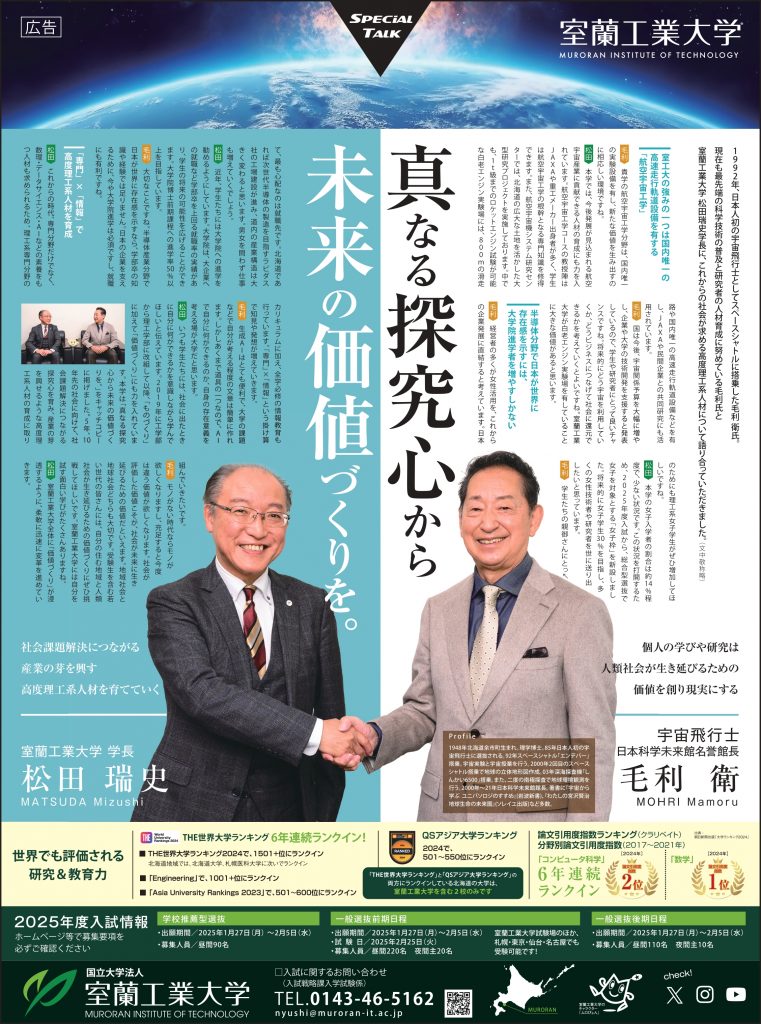
Mizushi Matsuda x Mamoru Mori, Hokkaido Shimbun Special Discussion "Creating value for the future with true curiosity"
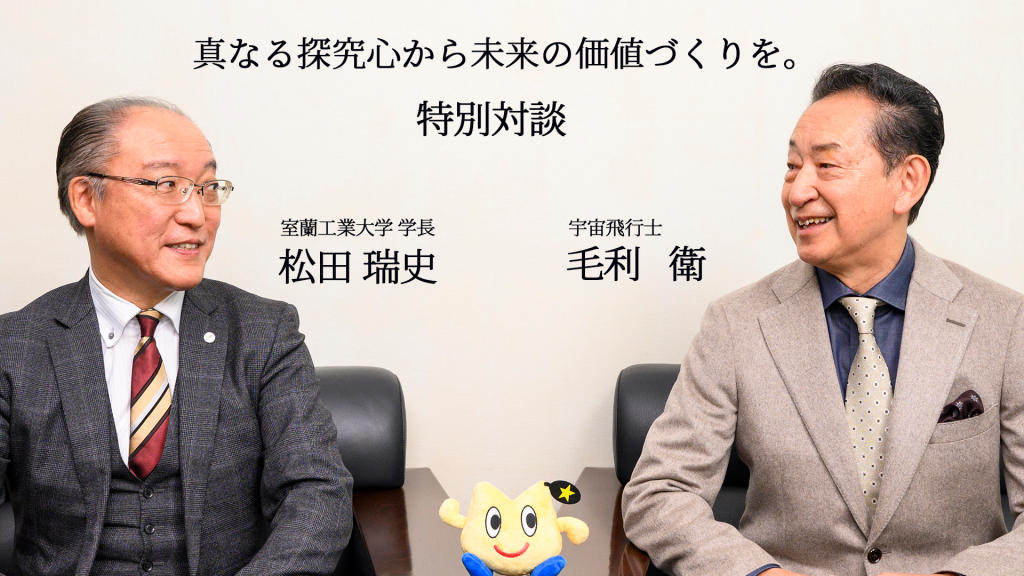
In 1992, Mamoru Mouri became the first Japanese astronaut to board the Space Shuttle. In a special dialogue published in the Hokkaido Shimbun (published December 14, 2024), Mr. Mouri and Muroran Institute of Technology Mizushi Matsuda President, who are still dedicated to promoting cutting-edge science and technology and nurturing researchers, discussed the advanced science and engineering talent society will seek in the future.
One of Muroran Institute of Technology's strengths is its "Aerospace Engineering" program, which boasts the only high-speed track facility in Japan.
Mori: Your university's aerospace engineering department has the only experimental facilities of their kind in Japan, making it an ideal environment for creating new value.
Matsuda: Our university is also committed to nurturing human resources who can contribute to the aerospace industry, which is expected to develop in the future. Many Professor Course of Aerospace Engineering come from JAXA and heavy industry manufacturers, allowing students to acquire specialized knowledge that forms the foundation of aerospace engineering. Additionally, The Aerospace Plane Research Center is conducting large-scale research projects that make use of Hokkaido's vast land. Among them, the Shiraoi Engine Testing Center, which can test rocket engines up to 1 ton, features an 800-meter runway and Japan's only high-speed track facility, and is also used for joint research with JAXA and private companies.
Mouri: The government has announced plans to significantly increase its space-related budget and support technology development for companies and universities, so it's a great opportunity for students and researchers. It would be good to think about how to utilize space in the future, how to connect it to business, and how to give back to society. I believe Muroran Institute of Technology having a Shiraoi engine testing facility is a great value.
-836x1024.jpg)
For Japan to establish a global presence in the semiconductor field, the only option is to increase the number of students pursuing graduate studies.
-925x1024.jpg)
Mori: Many business leaders believe that utilizing women is directly linked to the future development of their companies. I really hope that the number of female students in science and engineering fields will increase for the sake of Japan.
Matsuda: The percentage of female students at our university is currently low, at about 14%. To address this situation, we have established a new "women's quota" for the comprehensive selection process starting with the 2025 entrance examination. Our goal is to have 30% female students in the future and to produce many female engineers and researchers.
Mori: For the parents of these students, the biggest concern is job prospects. In Hokkaido, the construction of the Rapidus Corporation's factory, which aims to manufacture next-generation semiconductors, is progressing, and I think the industrial structure of the prefecture will change significantly. Job opportunities will increase for both men and women.
Matsuda: In recent years, we have been encouraging students to pursue graduate studies. Graduate schools have a track record of employment rates exceeding those of undergraduates, such as those seeking jobs at large companies, which can broaden students' future possibilities. We aim for an advancement rate of over 50% to graduate Master’s Course.
Mori: That's very important. If Japan is to establish a global presence in the semiconductor industry, the knowledge and experience gained from a bachelor's degree are insufficient. To support Japanese companies, graduate school is now essential, and it also gives you an advantage when it comes to finding a job.
Cultivating highly skilled science and engineering talent through a combination of "specialization" and "information technology."
Matsuda: In the coming era, there will be a demand for individuals with not only expertise in their specialized fields, but also skills in mathematics, data science, and AI. Therefore, in addition to the curriculum for science and engineering specialties, we also offer university-wide mandatory information technology education. The combination of "specialization" and "information technology" will increase knowledge and ideas.
Mouri: Generative AI is very convenient, and it can easily create sentences of a certain level that you can think of yourself for university assignments and the like. However, it is only one tool, so I think university is a place to think about what you can do with AI and your own purpose in life.
Matsuda: I always tell students to learn while being mindful of what they can do when they enter society. Since reorganizing from Faculty of Engineering to Faculty of Science and Engineering in 2019, we have been focusing not only on "manufacturing" but also on "value creation." Our university has adopted the catchphrase "Creating future value through genuine curiosity." Looking ahead to society five or ten years from now, I want to foster a spirit of inquiry that leads to solving social issues and foster highly advanced science and engineering talent who can sprout industries.
Mouri: In an era without goods, people want things, and once they are satisfied, they want different values. The values society values are the ones that enable society to survive in the future. Both local communities and global society are important. I hope that young people, including exam candidates, will take on the challenge of creating value for the survival of their communities and human society. Muroran Institute of Technology offers many interesting lessons to test yourself.
Matsuda: Muroran Institute of Technology We will flexibly and swiftly advance transformation so that "value creation" permeates the entire organization.
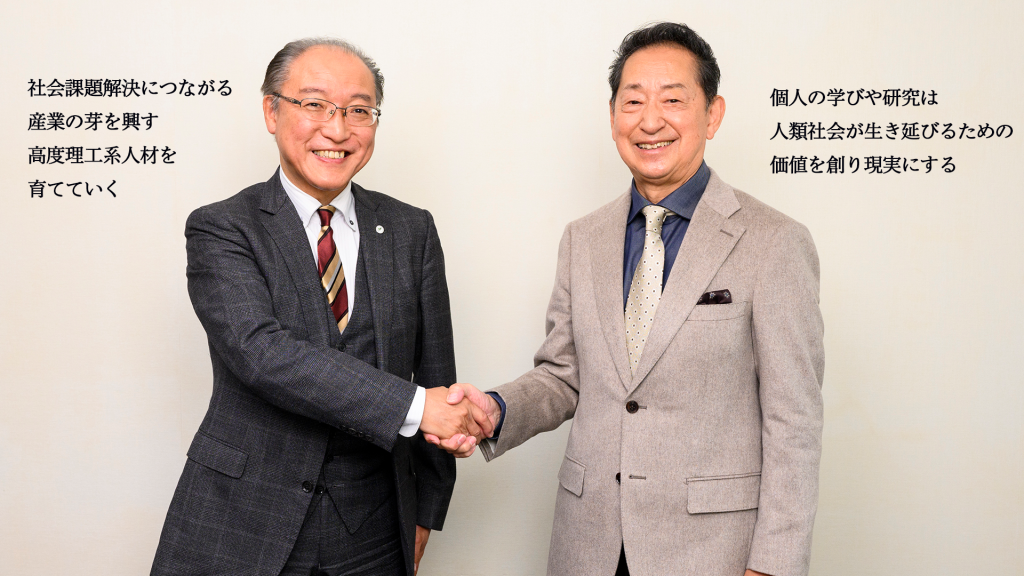
Full-page advertisement in the Hokkaido Shimbun (published December 14, 2024)