Innovation has created waves of economic fluctuation.
Discussing "Kondratiev waves"
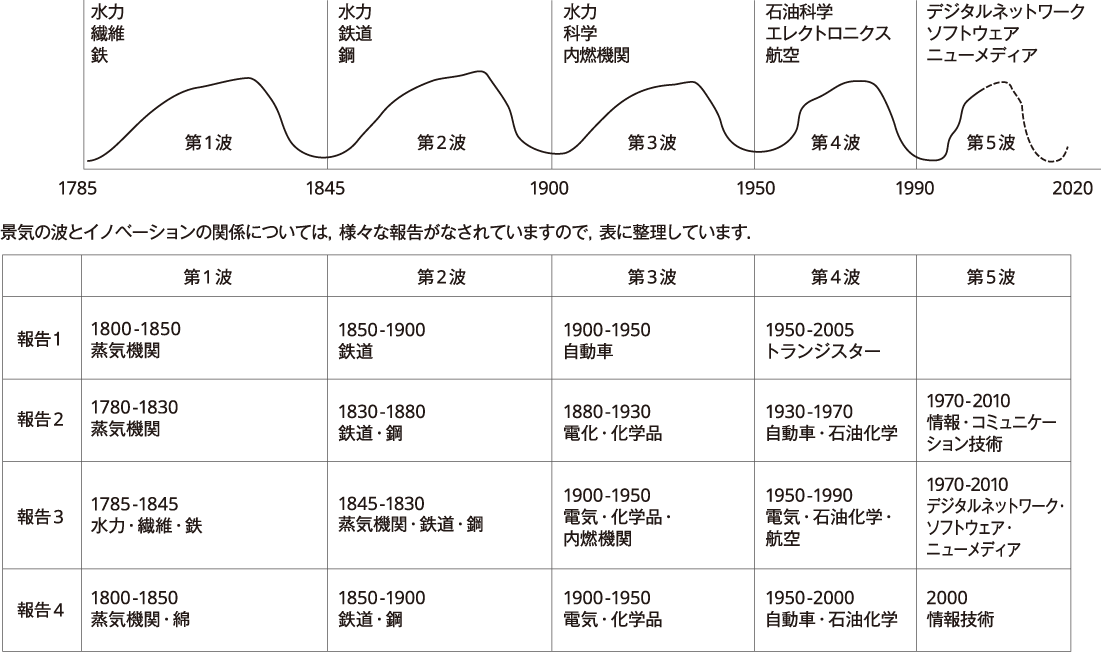
Russian economist Kondratiev believed that "economic cycles fluctuate cyclically, and innovation has played a major role as a contributing factor." Based on this idea, the relationship between economic cycles and innovation has been reported as shown in the diagram. Summarizing the four reports published so far, we get the table below.
"What kind of innovations will drive the next wave towards 2060?" To answer this question, let's organize the innovations related to power sources and transportation in the table below by wave.
[Wave 1: Steam engine] → [Wave 2: Railways] → [Wave 3: Engines (automobiles)] → [Wave 4: Aviation, computers] → [Wave 5: Digital network communication technologies]
We can see that they have come in this order. We believe that the next wave of innovation will be "information-based material and energy technology," in which material and energy technology and information technology are strongly combined.
Furthermore, the innovations related to materials in the table are
[Wave 1: Textiles and Cotton] → [Wave 2: Steel] → [Wave 3: Chemicals] → [Waves 4 & 5: Petrochemicals]
This is how things are unfolding. In the near future, when fossil fuels are recognized as a finite resource, their prices will skyrocket, making it difficult to produce materials like plastics, which are manufactured using petrochemical technology with crude oil as a raw material, cheaply and in large quantities. Therefore, we believe that technologies that could be called ecochemistry, which create various materials using renewable biomass as a raw material, and Materi-Ome technology, which manipulates the arrangement of molecules and atoms to manufacture materials, will create the next wave.